Miért vette meg a Garmin a TrainingPeaks-et?
Egy felvásárlás, amelyből szerintem csak az egyik fél járt jól
an acquisition from which, in my view, only one side came out well
An English version of this article follows below. Jump to the English version.
A Garmin felvásárolta a TrainingPeaks-et. A hír kapcsán az általános olvasat az volt, hogy a Garmin most majd beépíti a TrainingPeaks funkcióit a saját ökoszisztémájába, és ezzel erősebb edzésplatformot kínál. Én ezt a narratívát túlságosan leegyszerűsítettnek tartom. Az én olvasatomban a két rendszer alapjaiban különbözik, ezért valódi integráció nem is lesz, és a felvásárlás mögött egyetlen kézzelfogható motiváció áll. Ráadásul úgy látom, hosszú távon nem is a Garmin jár jól ezzel az üzlettel.
A tényállás röviden: a Garmin 2026. július 22-én jelentette be, hogy a TrainingPeaks mellett a TrainHeroic erőedzés-platformot is megvásárolja a Peaksware-től. Az ügylet kiválás volt, a Peaksware zeneoktatási üzletágai nem tartoztak bele, a pénzügyi feltételeket nem hozták nyilvánosságra. A TrainingPeaks már korábban is a Garmin partnere volt: a strukturált edzéseket a Garmin Connectbe szinkronizálta. Az alábbiakban a TrainingPeaks-re koncentrálok, mert az a nagyobb és ismertebb platform; a TrainHeroic szerepét nem elemzem. Az „integráció nem lesz” állításom ezért a mély integrációra vonatkozik, nem a már meglévő szinkronra.
1. Két platform, két külön világ
A Garmin Connect és a TrainingPeaks nem versenytársak, mert nem ugyanazt a problémát oldják meg, és soha nem is akarták. A Connect az eszköz köré épül. Az adatfolyam iránya egyértelmű: óráról a felhőbe, onnan a telefonra. A funkciók ebbe a logikába illeszkednek, szinkron, egészséggrafikonok, közösségi feed, előrecsomagolt tervek a Garmin Coach alatt, algoritmikus napi edzésjavaslat. A felhasználói kör széles: aki sportokosórát visel, az automatikusan itt van. Az adatok többségét nézik, nem elemzik.
A TrainingPeaks ezzel szemben az edző és a sportoló közös munkafolyamata köré épül. Az edzők itt terveznek, strukturált edzésblokkokból építkeznek, periodizálnak, makrociklust állítanak be. A sportoló végrehajtja a tervet, az edző pedig látja az eredményt és visszajelez. Ez a réteg a Garmin Connectben egyszerűen nem létezik. A sportoló oldalán ott a teljesítménymodell: a CTL, ATL és TSB mutatók, a TSS-alapú terhelés-periodizáció, a Performance Management Chart. A felhasználói kör szűk, de értékes: komoly állóképességi sportolók és hivatásos edzők.
2. Miért nem lehet igazán integrálni
Három okot látok, és mindhárom strukturális, nem technikai. Először: a két architektúra ellentétes irányba mutat. A Connect az eszközről érkező adatot dolgozza fel, a TrainingPeaks pedig a tervtől halad a végrehajtás felé. A TrainingPeaks értékének egy jelentős része éppen az, hogy platformfüggetlen, Polar, Suunto és Apple Watch felhasználók is használják. Ha a Garmin a saját platformjához köti, elveszíti a más gyártók eszközeit használó előfizetők egy részét.
Másodszor: az edző és a sportoló közötti kapcsolat nem egy funkció, amit át lehet portolni. A TrainingPeaks-et edzők adják el edzőknek, és ezeknek az edzőknek a sportolói gyakran vegyes eszközparkot használnak. Ez nem egy alkalmazás, hanem egy szakmai közösség és egy értékesítési csatorna, amelyet a Garmin nem tud egyszerűen átvenni.
Harmadszor: maga a terhelésszámítás matematikailag triviális, exponenciális mozgóátlagokról van szó. De a mutatók értelmezése, a mélyebb hatékonysági elemzés és a strukturált edzésterv felépítése együtt egy másik paradigma. Egy Connectbe áttolt teljesítménygrafikon megválaszolná a kérdést, hogy ad-e a Connect+ egyáltalán valamit, de attól még nem lenne TrainingPeaks.
3. Az egyetlen valós motiváció: a Connect+ megmentése
Ha a valódi integráció kizárt, akkor marad a kérdés, hogy a Garmin miért fizetett egyáltalán. Szerintem a válasz a Connect+ nevű fizetős előfizetésben van. A Connect+ indulása óta ugyanazzal a problémával küzd: mit ad a fizető felhasználónak, amit az ingyenes szint nem? Néhány haladó widget és plusz edzésjavaslat nem indokol havidíjat annak, aki már kifizetett több száz dollárt a hardverért. Az iparági viszonyítási pont egyértelmű: a Strava, a Whoop és az Apple Fitness+ mind konkrét, rendszeresen frissülő tartalomértéket ad. A Connect+ ezzel szemben lényegében statikus ajánlatot kínál, és pontosan ez az a szerkezet, amin a fizetős konverziós modellek rendre elvéreznek.
A TrainingPeaks felvásárlása erre ad választ. Egy érett, milliós nagyságrendű felhasználói bázissal és bejáratott edző-ökoszisztémával rendelkező platform hiteles teljesítményelemzési tartalmat és narratívát hoz a Connect+ mögé. Nem kódintegrációval, hanem márkanévvel és tartalommal. Ezért gondolom, hogy ez nem offenzív, piacszerző felvásárlás, hanem defenzív tartalom-akvizíció. A Garmin belülről nem tudta felépíteni a Connect+ értékajánlatát, mert nincs edzőközössége és nincs a TrainingPeaks méretű periodizációs tudásbázisa. A vételárat nem hozták nyilvánosságra, ezért csak a logikából következtetek: egy védekező lépés várható ára ez, nem egy növekedési tézisre épített prémium.
4. Az AI edzők dömpingje, avagy miért a TrainingPeaks járt jól
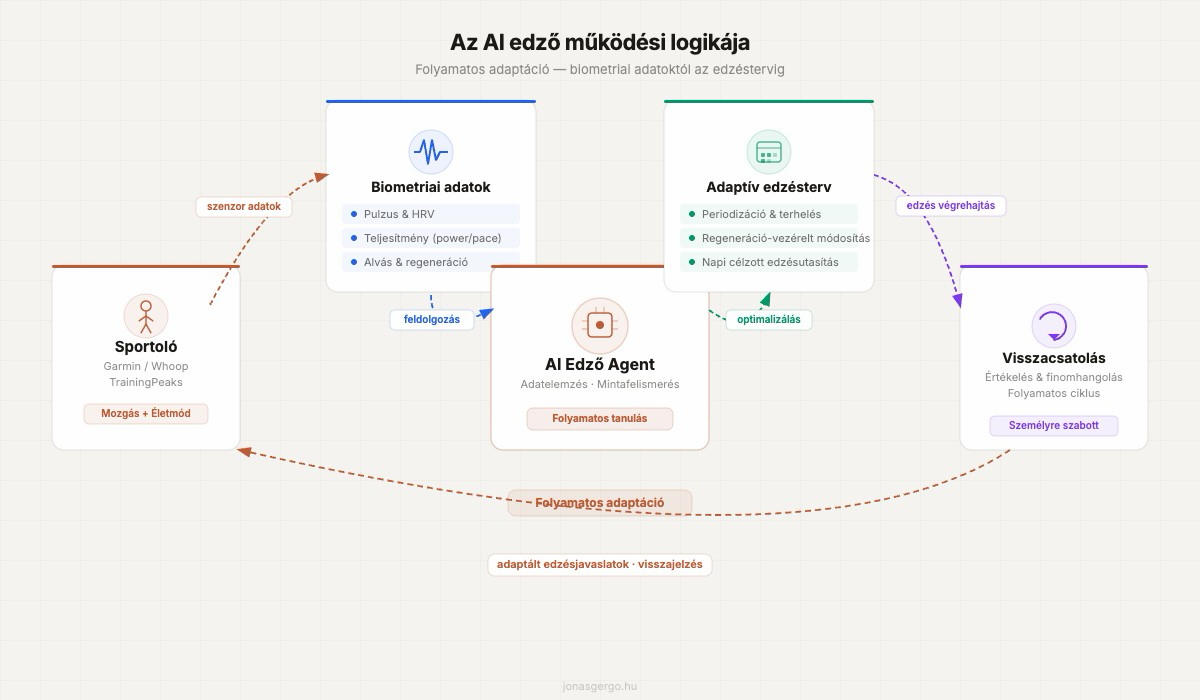
A másik meggyőződésem, hogy ebből a felvásárlásból valójában a TrainingPeaks jött ki jól, és ennek az oka az AI edzők robbanásszerű terjedése. Néhány éve egy személyre szabott edzőszoftver megépítése komoly sporttudományi, gépi tanulási és adatpipeline-fejlesztést igényelt. Ma mindez lecsökkent egy API-kulcs árára. A jelenlegi nagy nyelvi modellek, a GPT-4o, a Claude és a Gemini elegendő következtetési képességgel rendelkeznek az általános edzéstervezéshez, finomhangolás nélkül, egy jól megírt rendszerprompttal.
Az agent-keretrendszerek, mint a LangChain, a CrewAI vagy az idén szabvánnyá vált Model Context Protocol, lehetővé teszik, hogy ezek az alkalmazások ne csak válaszoljanak, hanem cselekedjenek is: lekérdezik a Garmin Connect vagy a Strava adatait, elemzik az előző hét terhelését, majd személyre szabott heti tervet generálnak. Az appstore-ökoszisztéma ezt még gyorsítja. A Claude Projects és a ChatGPT Custom GPTs funkcióval bárki tíz perc alatt, kód nélkül létrehozhat egy személyes AI edzőt. A no-code platformokon nem szoftverfejlesztők, hanem személyi edzők, futóklubok és lelkes amatőrök adnak ki napi szinten ilyen alkalmazásokat, nulla és tíz euró közötti áron, szemben egy emberi edző havi száz-háromszáz eurós díjával. Ami 2024-ben pár száz ilyen appot jelentett, az mára napi megjelenéssé vált.
Ez a hullám pontosan azt a versenyelőnyt bontja le, amelyre a TrainingPeaks épült. A platform három pilléren állt: a strukturált edzésadatokon, a tanúsított edzők piacterén és a kész edzéstervek ökoszisztémáján. Mindhárom egyszerre gyengül. Az edzői tudás közárucikké válik, hiszen a legtöbb amatőr számára egy egyszerű volumen-intenzitás arány ugyanolyan hasznos, mint a precíz TSS. Az edző és a sportoló kapcsolatának ára zuhan: ha valaki napi visszajelzést és heti tervmódosítást kap egy AI-tól tíz euróért, akkor az emberi edző már tudatos prémiumválasztás lesz, nem az egyetlen elérhető megoldás. A növekedés pedig exponenciális, mert minden sikeres prototípus nyílt forráskódban vagy klónként sokszorozódik.
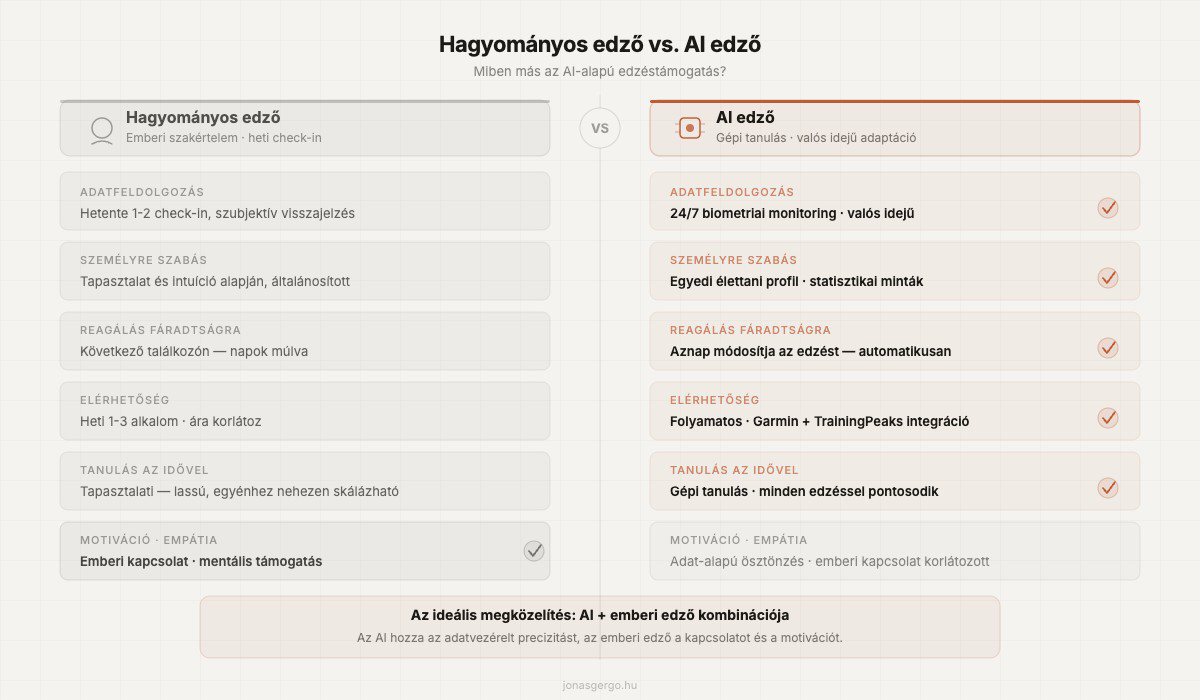
Nem az a kérdés, hogy lesz-e AI edzője az állóképességi sportolónak, hanem az, hogy melyik platform lesz az négy év múlva. A meglévő szereplők már ma is a TrainingPeaks felhasználóiért versenyeznek. A TrainerRoad Adaptive Training kerékpáros fókusszal, saját adaptív algoritmussal a teljesítmény alapján módosítja a terveket. A TriDot triatlonra specializált AI-periodizációt kínál globális versenyadatokból. Az Athletica.ai tudományos háttérrel, HRV-integrációval nő gyorsan. A Runna a futók körében terjed erős felhasználói élménnyel, a WHOOP Coach pedig a saját regeneráció-alapú logikájával ad napi edzésjavaslatot. A közös nevező, hogy mindegyik azt csinálja, amit a Connect+ ígérhetne, de a jelenlegi, statikus Garmin Coach tartalommal nem tud. Éppen ez a Garmin gondja.
Fontos látni, hogy a komoly versenysportolók a jövőben sem fognak kizárólag AI-ra támaszkodni. Náluk a precíz teljesítménymodell és a tapasztalt edző személyes szeme valódi különbséget jelent, és az AI náluk is legfeljebb beépül az edzésmunkába, nem váltja ki azt. A TrainingPeaks bevételét azonban eddig sem elsősorban ez a szűk élsportoló-kör adta, hanem a tömeges, hobbiszinten versenyző amatőr réteg. Éppen ők azok, akik a legkönnyebben, tömegesen térhetnek át egy olcsó, de elég jó AI edzőre, és éppen ez a réteg a platform valódi bevételi bázisa.
Ez a hatás ráadásul nem áll meg a TrainingPeaks-nél. Ugyanez a tömeges elvándorlás a teljes online edzői szolgáltatási piacot érintheti, a hazai szereplőket is, például az Ensportot vagy a Plandurance-t. A nyilvános információk alapján úgy látom, hogy ezek üzleti modellje szintén a céldátumra készülő, közepes szintű hobbisportolóra épül, akinek az edző elsősorban tervező és motiváló. Ha ezt a szerepet egy AI edző a töredékéért, elfogadható minőségben ellátja, akkor ezeknél a szolgáltatásoknál is ügyfélvesztés várható a következő néhány évben. Ez az én becslésem, nem a cégek adata. Nem a teljes piac tűnik el, de a belépő és középszegmens, amelyből a bevétel nagy része származik, komoly nyomás alá kerül.
5. Ki járt jól valójában
A Garmin szükségből vásárolt. A Connect+ tartalomhiányát kellett megoldania, és a TrainingPeaks volt a leggyorsabb megoldás. Strukturálisan viszont szerintem rossz fogást tett. A TrainingPeaks-et a platformfüggetlensége teszi vonzóvá az edzők számára, és pontosan ezt a tulajdonságát veszíti el lassan a Garmin-tulajdon alatt. A felvásárlás legnagyobb kockázata nem az integráció, hanem a márkaérték megőrzése. A TrainingPeaks felhasználói, a triatlonisták, a versenyzők és az edzők, erősen márkahűek és technológiakritikusak. Ha a Garmin-tulajdon hatásai láthatóvá válnak, egyszerűsített felület, szinkronkényszer vagy áremelés formájában, akkor a mag-közösség elvándorol, pontosan abba a vákuumba, amelyet az AI-natív edzőplatformok töltenének be.
A felvásárlás értéke tehát csak akkor realizálódik, ha a Garmin tartózkodik az integrációtól, és megtartja a TrainingPeaks önállóságát. Ez M&A szempontból ritka önfegyelem, és a Garmin eddigi platformdöntései alapján nem vennék rá mérget. Aki ebből valóban jól járt, az a TrainingPeaks korábbi tulajdonosi köre: egy érett, de egyre fenyegetettebb pozíciót adtak el, éppen mielőtt az AI edzők hulláma teljes erővel elérné. A felvásárlás előtt a TrainingPeaks veszélyeztetett volt, de független. Utána egy gyártó terméke lett egy olyan közösség számára, amely lényegében gyártófüggetlen. Ezt a feszültséget nehéz lesz feloldani.
Ez a cikk saját véleményem és elemzésem. A benne szereplő platformok és mutatók valós példák, a piaci következtetések a saját megítélésemet tükrözik.
Van kérdésed, vagy beszélgetnél a témáról? Írj emailben: info@jonasgergo.hu, vagy keress meg LinkedInen.
English version
Garmin has bought TrainingPeaks. The general reading of the news was that Garmin will now build the TrainingPeaks features into its own ecosystem and thereby offer a stronger training platform. I find this narrative oversimplified. In my reading, the two systems are fundamentally different, so there will be no real integration, and the acquisition has a single tangible motive behind it. On top of that, I do not think Garmin comes out ahead in the long run.
The facts in brief: on 22 July 2026 Garmin announced that it is acquiring the TrainHeroic strength-training platform from Peaksware together with TrainingPeaks. The deal was a carve-out, Peaksware's music-education businesses were not part of it, and the financial terms were not disclosed. TrainingPeaks was already a Garmin partner before the deal: it synced structured workouts to Garmin Connect. Below I concentrate on TrainingPeaks, because it is the larger and better-known platform; I do not analyse the role of TrainHeroic. My claim that there will be no integration therefore refers to deep integration, not to the sync that already exists.
1. Two platforms, two separate worlds
Garmin Connect and TrainingPeaks are not competitors, because they do not solve the same problem, and never set out to. Connect is built around the device. The direction of the data flow is clear: from the watch to the cloud, from there to the phone. The features fit this logic: sync, health charts, a social feed, pre-packaged plans in Garmin Coach, an algorithmic daily workout suggestion. The user base is wide: anyone who wears a sports watch is automatically a user. Most of the data is looked at, not analysed.
TrainingPeaks, by contrast, is built around the shared workflow of the coach and the athlete. Coaches plan here: they build from structured workout blocks, periodise and set up macrocycles (long-term training cycles). The athlete carries out the plan, and the coach sees the result and gives feedback. This layer simply does not exist in Garmin Connect. On the athlete's side there is the performance model: the CTL (chronic training load), ATL (acute training load) and TSB (training stress balance) metrics, load periodisation based on TSS (training stress score), and the Performance Management Chart. The user base is narrow but valuable: serious endurance athletes and professional coaches.
2. Why they cannot really be integrated
I see three reasons, and all three are structural, not technical. First: the two architectures point in opposite directions. Connect processes the data arriving from the device, while TrainingPeaks moves from the plan towards execution. A significant part of the value of TrainingPeaks is precisely that it is platform-independent, used also by Polar, Suunto and Apple Watch users. If Garmin ties it to its own platform, it loses some of the subscribers who use other manufacturers' devices.
Second: the relationship between coach and athlete is not a feature that can be ported over. TrainingPeaks is sold by coaches to coaches, and the athletes of these coaches often use a mix of devices. This is not an application but a professional community and a sales channel, which Garmin cannot simply take over.
Third: the load calculation itself is mathematically simple: it is a matter of exponential moving averages. But the interpretation of the metrics, the deeper efficiency analysis and the building of a structured training plan together are a different paradigm. A performance chart pushed over into Connect would answer the question of whether Connect+ gives anything at all, but it still would not be TrainingPeaks.
3. The only real motive: rescuing Connect+
If real integration is ruled out, the question remains why Garmin paid at all. In my view the answer lies in the paid subscription called Connect+. Since its launch Connect+ has struggled with the same problem: what does it give the paying user that the free tier does not? A few advanced widgets and extra workout suggestions do not justify a monthly fee for someone who has already paid several hundred dollars for the hardware. The industry benchmark is clear: Strava, Whoop and Apple Fitness+ all offer concrete, regularly refreshed content. Connect+, by contrast, offers an essentially static proposition, and this is exactly the structure on which free-to-paid conversion models regularly fail.
The acquisition of TrainingPeaks answers this. A platform with a mature user base on the order of millions and an established coach ecosystem lends Connect+ credible performance-analysis content and a credible narrative. Not through code integration but through brand and content. That is why I think this is not an offensive, market-expanding acquisition but a defensive content acquisition. Garmin could not build the Connect+ value proposition in-house, because it has no coach community and no periodisation knowledge base on the scale of TrainingPeaks'. The purchase price has not been made public, so I can only infer from the logic of the deal: this looks like the price of a defensive move rather than a premium built on a growth thesis.
4. The flood of AI coaches, or why TrainingPeaks came out ahead
My other conviction is that it is actually TrainingPeaks that came out ahead in this acquisition, and the reason is the explosive spread of AI coaches. A few years ago, building personalised coaching software required serious sports-science, machine-learning and data-pipeline development. Today all this comes down to the price of an API key. The current large language models, GPT-4o, Claude and Gemini, have enough reasoning ability for general training planning, without fine-tuning, with a well-written system prompt.
Agent frameworks, such as LangChain, CrewAI or the Model Context Protocol that became a standard this year, allow these applications not only to answer but also to act: they query the data of Garmin Connect or Strava, analyse the previous week's load, and then generate a personalised weekly plan. The app-store ecosystem speeds this up further. With Claude Projects and ChatGPT's custom GPTs, anyone can create a personal AI coach in ten minutes without writing code. On the no-code platforms it is not software developers but personal trainers, running clubs and enthusiastic amateurs who release such applications every day, at prices from free to ten euros, compared with a human coach's monthly fee of 100 to 300 euros. What meant a few hundred such apps in 2024 has by now become a daily occurrence.
This wave undermines exactly the competitive advantage on which TrainingPeaks was built. The platform stood on three pillars: structured training data, a marketplace of certified coaches and an ecosystem of ready-made training plans. All three weaken at once. Coaching knowledge becomes a commodity, since for most amateurs a simple volume-intensity ratio is as useful as a precise TSS. The price of the coach-athlete relationship plunges: if someone gets daily feedback and weekly plan changes from an AI for ten euros, then a human coach becomes a conscious premium choice, not the only available solution. And the growth is exponential, because every successful prototype multiplies as open source or as a clone.
The question is not whether an endurance athlete will have an AI coach, but which platform it will be on in four years. The existing players are already competing today for the users of TrainingPeaks. TrainerRoad Adaptive Training, with a cycling focus and its own adaptive algorithm, adjusts plans based on performance. TriDot offers AI periodisation specialised for triathlon from global race data. Athletica.ai is growing fast, with a scientific grounding and HRV (heart rate variability) integration. Runna is spreading among runners thanks to its strong user experience, and WHOOP Coach gives a daily training suggestion with its own recovery-based logic. The common denominator is that all of them do what Connect+ could promise but cannot deliver with its present, static Garmin Coach content. That is exactly Garmin's problem.
It is worth noting that serious competitive athletes will not rely on AI alone in the future either. For them a precise performance model and the personal eye of an experienced coach make a real difference, and at most AI gets built into their training work rather than replacing it. The revenue of TrainingPeaks, however, has so far not come primarily from this narrow circle of elite athletes, but from the mass of amateurs who compete at hobby level. They are exactly the ones who can switch most easily, in large numbers, to a cheap but good-enough AI coach, and exactly this segment is the real revenue base of the platform.
This effect, moreover, does not stop at TrainingPeaks. The same mass migration may affect the whole online coaching services market, Hungarian providers too, for example Ensport or Plandurance. Judging by publicly available information, their business model is also built on the mid-level hobby athlete preparing for a target date, for whom the coach is primarily a planner and motivator. If an AI coach fills this role for a fraction of the price and at acceptable quality, customer loss can be expected at these services too over the next few years. This is my own estimate, not the companies' data. The whole market does not disappear, but the entry-level and mid-level segments, which bring in most of the revenue, will come under serious pressure.
5. Who really came out ahead
Garmin bought out of necessity. It needed to fill the content gap in Connect+, and TrainingPeaks was the fastest way to do it. Structurally, though, I think it made a poor choice. Platform independence is what makes TrainingPeaks attractive to coaches, and it is exactly this property that it risks losing slowly under Garmin ownership. The biggest risk of the acquisition is not integration but preserving brand value. The users of TrainingPeaks, the triathletes, the competitors and the coaches, are strongly brand-loyal and critical of technology. If the effects of Garmin ownership become visible, in the form of a simplified interface, forced sync or a price rise, then the core community will migrate away, straight into the vacuum that AI-native coaching platforms would fill.
The value of the acquisition is therefore realised only if Garmin refrains from integration and keeps the independence of TrainingPeaks. From an M&A point of view this would be rare self-discipline, and judging by Garmin's platform decisions so far I would not bet on it. The one who really came out ahead is the former ownership of TrainingPeaks: they sold a mature but increasingly threatened business just before the wave of AI coaches reaches full force. Before the acquisition TrainingPeaks was under threat but independent. Afterwards it became a manufacturer's product serving a community that is essentially manufacturer-agnostic. This tension will be hard to resolve.
This article is my own opinion and analysis. The platforms and metrics mentioned in it are real examples, and the market conclusions reflect my own judgement.
Do you have a question, or would you like to talk about the topic? Write to me by email: info@jonasgergo.hu, or find me on LinkedIn.